The Infrastructure Pole Dilemma
When planning a new street lighting project, highway installation, or telecom infrastructure deployment, one of the most critical decisions is choosing the right pole material. For decades, the choice was simple: steel or concrete. But today, a third option is transforming infrastructure development across India and globally. Glass Fiber Reinforced Polymer (GFRP) composite poles.
Understanding the differences between these three materials isn’t just a technical exercise. It directly impacts project budgets, maintenance costs, installation timelines, and long-term reliability. Let’s break down the comparison across the factors that matter most to project managers, contractors, and procurement teams.
Initial Cost: Closer Than You Think
The most common misconception about composite poles is that they’re significantly more expensive than steel. While that may have been true a decade ago, the gap has narrowed dramatically. Steel prices have risen sharply in recent years, while composite manufacturing has become more efficient. Today, GFRP composite poles are at near-parity with galvanized steel poles on initial purchase price, and often comparable to pre-stressed concrete poles.
But initial cost is only one part of the equation. The real question is: what does a pole cost you over its entire lifetime?
Total Cost of Ownership: Where Composite Wins Decisively
Consider a 20-year horizon for a street lighting project with 100 poles. Steel poles require regular maintenance including repainting every 3-5 years, earthing system checks, and eventual replacement due to corrosion (typical steel pole lifespan is 15-20 years in normal conditions, as low as 9 years in coastal or industrial environments).
Concrete poles, while durable, are extremely heavy. A single 9-meter concrete pole weighs 800-1200 kg, requiring cranes and heavy vehicles for transport and installation. Transportation costs alone can add 20-30% to project budgets, especially for remote or rural locations.
GFRP composite poles, by contrast, have a design life of 50 years with zero maintenance required. No painting, no earthing, no corrosion treatment. A composite pole weighing just 35-50 kg (for the same 9-meter height) can be carried and installed by two workers. When you factor in reduced maintenance, lower transport costs, faster installation, and dramatically longer lifespan, composite poles deliver 30-40% lower total cost of ownership compared to steel.
Performance in Harsh Environments
India’s geography presents unique challenges for infrastructure materials. Coastal regions face salt spray and high humidity. Industrial zones expose poles to chemical vapors and acid rain. Cyclone-prone areas demand high wind resistance.
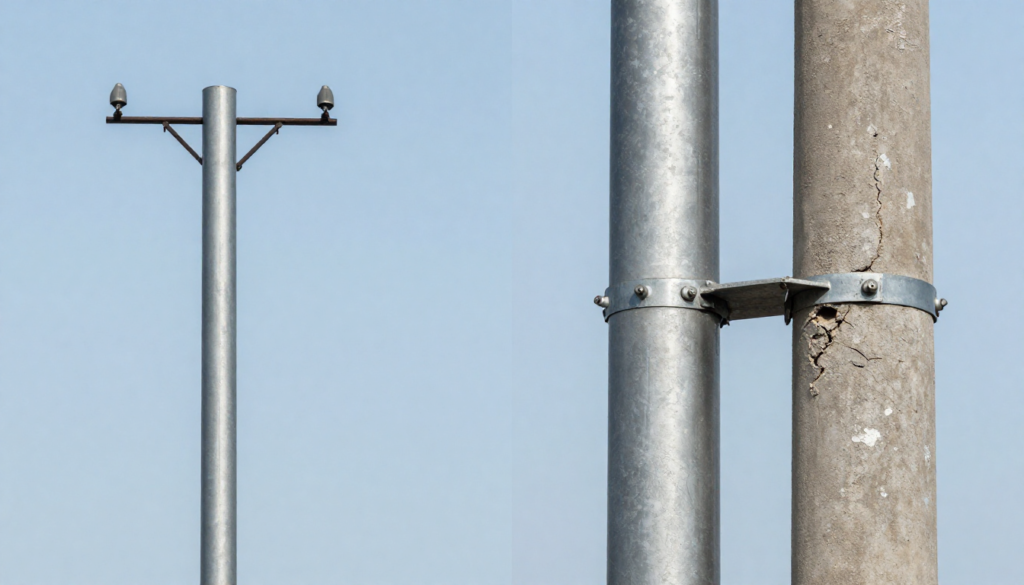
Steel corrodes. Even with galvanization and regular painting, steel poles in coastal environments degrade rapidly. Concrete resists corrosion but cracks under repeated wind stress and is vulnerable to carbonation over time.
GFRP composite poles are inherently corrosion-proof. The composite material is unaffected by salt water, humidity, acid rain, or chemical exposure. High-performance filament wound poles (like those manufactured by Helipole) are rated for wind speeds up to 180 kmph, making them ideal for cyclone-prone coastal regions. The material’s natural flexibility allows it to absorb wind loads without cracking.
Safety: The Non-Negotiable Factor
Here’s a factor that rarely appears in cost comparisons but saves lives: electrical conductivity. Steel poles are conductive. Every steel pole near electrical infrastructure requires earthing, and a fault in the earthing system creates a lethal shock hazard for pedestrians and workers.
GFRP composite poles are completely non-conductive. They require no earthing whatsoever. In the event of a power line fault or wiring issue, the pole itself poses zero electrocution risk. For municipalities responsible for public safety, this is a compelling advantage.
In accident scenarios, lightweight composite poles cause significantly less damage to vehicles and passengers than heavy steel or concrete poles. Several countries are now mandating or recommending ‘frangible’ (breakaway) poles near highways for this reason.
Installation Speed: Time Is Money
Project timelines matter. Concrete pole installation requires heavy cranes, deep foundations, and curing time. A team might install 5-8 concrete poles per day.
Steel poles are lighter than concrete but still require specialized equipment and earthing installation. A team can typically handle 10-15 poles per day.
Composite poles, at 1/8th the weight of concrete and 2/3rd the weight of steel, can be installed by a small crew of 2-3 workers. Installation rates of 20-30 poles per day are common, dramatically reducing project timelines and labor costs.
Making the Right Choice for Your Project
The shift to composite poles is accelerating across India. Government programs like the Smart Cities Mission, 5G rollout, and rural electrification schemes are increasingly specifying or preferring FRP composite materials for their infrastructure advantages.
For any project where long-term cost efficiency, corrosion resistance, installation speed, or electrical safety are priorities, GFRP composite poles represent the most technically sound and financially prudent choice. The initial cost is competitive, and the lifetime savings are substantial.
Ready to See the Composite Advantage for Your Project?
Helipole manufactures premium filament wound GFRP composite poles for street lighting, telecom, and electrical distribution. With 8+ years of proven deployments across AAI airports, highways, sea ports, and industrial facilities backed by CPRI, ISO, and ASTM certifications we deliver poles built for 30-50 years of zero maintenance. Zero Maintenance. Zero Risk.