The Coastal Corrosion Crisis
India has over 7,500 kilometers of coastline, supporting some of the nation’s most critical infrastructure: ports, highways, airports, industrial zones, and rapidly growing coastal cities. Every piece of infrastructure along this coastline faces a relentless enemy: corrosion.
Salt-laden air, high humidity, and direct salt spray exposure create an environment where conventional steel poles degrade at accelerated rates. Municipal corporations and infrastructure agencies along India’s coast spend crores annually replacing corroded steel poles — often within 8-10 years of installation, far short of their intended 20-year lifespan.
Understanding Coastal Corrosion
Coastal environments are classified by corrosion engineers as C4 (high corrosion) to CX (extreme corrosion) zones under ISO 12944. In these zones, standard hot-dip galvanized steel loses 4-8 micrometers of zinc coating per year. Within 10-15 years, the protective layer is gone and base metal corrosion begins.
The effects are visible across India’s coastal cities: rusting poles leaning at angles, flaking paint revealing orange-brown metal beneath, and in extreme cases, poles collapsing entirely. Beyond aesthetics, corroded poles are structural liabilities and safety hazards.
Traditional solutions like extra-thick galvanization, duplex coating systems, or stainless steel add significant cost. Even with these measures, the underlying vulnerability to salt and moisture remains.
Why GFRP Composite Poles Are Inherently Corrosion-Proof
Glass Fiber Reinforced Polymer (GFRP) composite material is fundamentally different from metals. It does not contain any ferrous materials, so there is nothing to oxidize. Salt spray, humidity, sea water, and acid rain have no corrosive effect on the composite structure.
This isn’t just theory. Filament wound GFRP poles have been deployed in marine environments globally for over three decades with zero corrosion degradation. The material’s UV-resistant coating further protects against sun exposure, ensuring the pole retains its structural integrity and appearance throughout its 30-50 year design life.
For coastal infrastructure planners, this means: install once, maintain never. No repainting schedules, no corrosion inspections, no emergency replacements.
Additional Benefits for Coastal Environments
Beyond corrosion resistance, GFRP composite poles offer several advantages specifically relevant to coastal infrastructure. First, wind resistance: cyclone-prone coastal regions require poles rated for extreme wind speeds. High-performance filament wound poles achieve ratings of 180 kmph, exceeding the typical 150 kmph rating of conventional poles.
Second, lightweight design matters enormously for coastal installations. Many coastal projects involve installation on sandy or soft ground, beach promenades, harbor areas, or elevated coastal roads where heavy equipment access is limited. A composite pole weighing 35-50 kg can be manually carried to challenging installation sites.
Third, composite poles are non-conductive. In coastal areas with high moisture levels, the risk of electrical faults causing shock hazards is elevated. Non-conductive poles eliminate this risk entirely, requiring no earthing system.
Real-World Coastal Applications
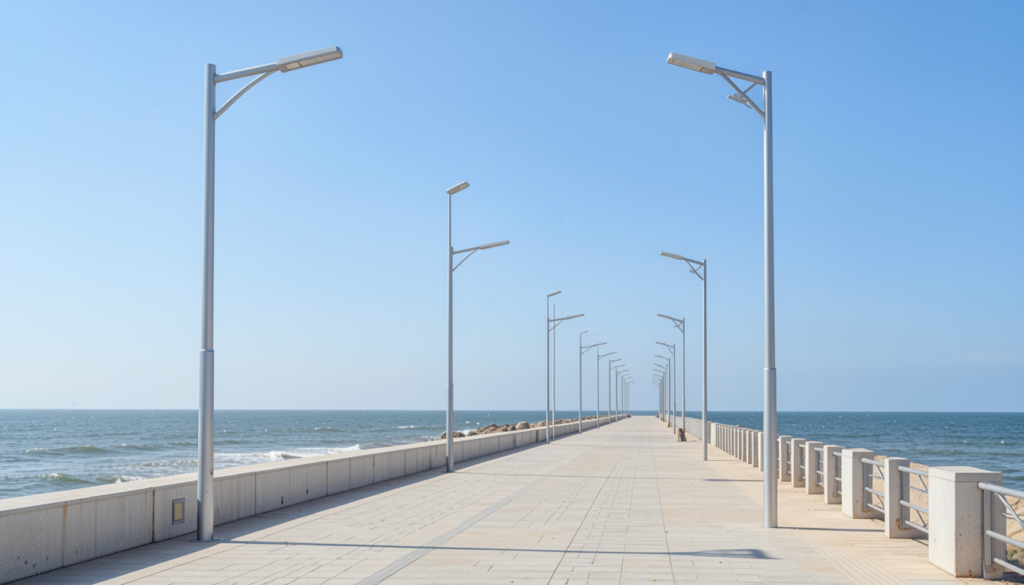
GFRP composite poles are already deployed in demanding coastal environments across India. Visakhapatnam, one of India’s major port cities and home to the Eastern Naval Command, has installed composite poles along its coastal roads and promenades. These installations face direct sea spray and high humidity daily, yet maintain their structural and aesthetic quality years after installation.
Internationally, coastal regions in the Middle East, Southeast Asia, and the Americas have adopted composite poles for port lighting, marina installations, and coastal highway lighting. The material’s performance record in these environments has driven increasing specification in tender documents for coastal projects.
Cost Analysis: Coastal Projects
For a typical coastal lighting project of 200 poles over a 20-year period, the total cost comparison is stark. Steel poles in coastal zones require repainting every 2-3 years (versus 4-5 years inland), corrosion inspections annually, and replacement at approximately 10-12 years. Adding up maintenance, labor, traffic management costs for maintenance activities, and replacement poles, the 20-year cost can be 2.5 to 3 times the initial purchase price.
GFRP composite poles at the same specification have zero maintenance cost over the same 20-year period, with a design life extending well beyond to 50 years. The initial investment is recovered within 5-7 years through maintenance savings alone.
Protect Your Coastal Infrastructure Investment
Helipole’s filament wound GFRP poles are engineered specifically for harsh environments. With 180 kmph wind rating, zero corrosion, and 30-50 year design life, they’re the smart choice for any coastal project. Zero Maintenance. Zero Risk. Our manufacturing facility in Visakhapatnam — a major Indian port city — gives us deep understanding of coastal challenges and enables fast delivery to coastal regions.